
1. Take up a job
A job offer or employer-linked visa can provide a route to work in New Zealand. The availability and terms of work depend on occupation, employer, visa rules and labour demand.
Migration is not one-way or one story. People arrive for work, study, family, safety and other opportunities; people leave for a similarly varied mix of reasons. The balance changes with economic conditions, borders, policy settings and personal circumstances.
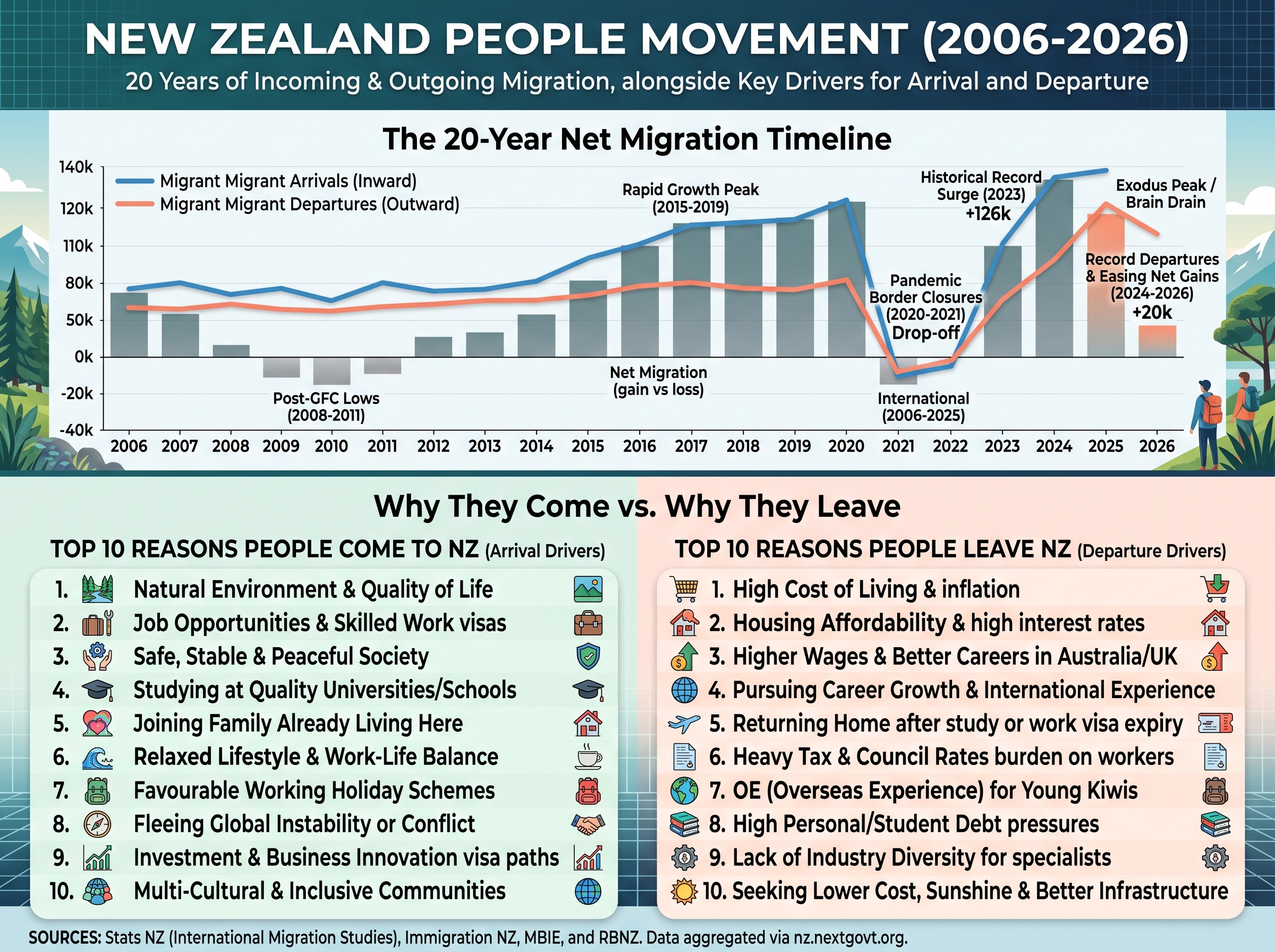
The graphic’s migration values, trend labels and numbered reasons are supplied claims, not verified data or a measured ranking. Use the sourced timeline and unranked motivation categories below instead.
The period includes changing migration demand, the COVID-19 border interruption, a sharp reopening rebound and renewed outward movement by New Zealand citizens. Net migration is arrivals minus departures; always check whether a figure refers to all migrants or to citizens only.
Arrivals and departures continued across permanent, long-term and temporary pathways. New Zealand citizen movements—particularly travel between New Zealand and Australia—could move differently from the overall migration balance.
Employment prospects and family circumstances shifted as the global financial crisis affected New Zealand and other destinations. Annual net migration combines several different groups, so a single total cannot show why individuals moved.
New Zealand experienced a period of stronger net migration, including work, study, family and returning-citizen movements. Changes in visa settings and labour demand formed part of the context; timing alone does not establish how much either caused the change.
Public-health measures and border restrictions reduced arrivals and departures. Temporary visa holders, international students, returning residents and New Zealand citizens faced different circumstances; the period is not directly comparable with ordinary border years.
International travel and migration resumed. Stats NZ reported a provisional record net migration gain of 135,500 in the year ended October 2023; provisional estimates can be revised, and that headline does not describe every group’s experience.
New Zealand citizen departures increased while non-citizen migration continued to contribute to overall population change. Read the citizen and non-citizen series separately, and check the latest release date before quoting a current total.
Sources and definitions: Stats NZ migration statistics; International migration: October 2023; International migration: December 2025. Migration estimates are provisional and may be revised.
These categories describe established visa routes and commonly considered personal motivations. They are not ranked by prevalence: visa data records a pathway or visa type, which is not always the person’s only or main reason for moving.
A job offer or employer-linked visa can provide a route to work in New Zealand. The availability and terms of work depend on occupation, employer, visa rules and labour demand.
Some people move to pursue professional development, experience or roles that match their skills. This is a motivation to investigate, not a reason measured for every migrant.
International students may choose New Zealand for a qualification, research or a period of study abroad. A student visa does not by itself indicate an intention to settle permanently.
Partner visa categories provide routes for people whose partner is a New Zealand citizen, resident or eligible visa holder.
Family categories enable eligible people to join relatives, subject to the specific visa requirements and places available.
New Zealand citizens and residents may return after living, working or studying overseas. Their return contributes to arrivals, but may not be counted as an immigration visa approval.
Refugees and people seeking protection may come through humanitarian and protection pathways. Safety is distinct from an elective work or study migration route.
Working-holiday schemes allow eligible young people from partner countries to travel and take temporary work under scheme conditions.
Business and investment routes can attract people bringing capital, business experience or plans to operate in New Zealand, subject to current policy settings.
People may value New Zealand’s environment, community, safety or pace of life. These preferences are individual and are not captured as a standard reason in migration counts.
These are factors to consider, not a ranked or fully measured list. Departure records show that someone left and may identify citizenship or destination; they generally do not establish the person’s motivation.
A job offer or demand for particular skills can draw people to another labour market. Compare wages, employment conditions, occupation and destination before attributing a move to one cause.
People may move for promotion, professional networks, larger markets or international experience. Administrative departure data does not measure these motivations.
Education, research, placements and specialist training can lead to a temporary or longer-term move.
Relationships, caregiving and family reunification can influence where people choose to live, including moves in either direction.
Some temporary workers, students and other visa holders leave when their plans or visa period end. Departure totals do not reveal whether the move was planned or permanent.
Citizens may move to Australia or elsewhere for work, family, study or lifestyle. Track citizen flows separately from non-citizen migration.
Housing affordability and household expenses may feature in a person’s decision. The strength of this factor for departures needs direct survey evidence; movement counts alone cannot establish it.
Climate, recreation, urban scale and personal preferences can shape where people live. These are subjective considerations, not measured reasons in standard migration totals.
Retirement plans, family networks and access to services can prompt a move, including returning to a country of origin or joining relatives abroad.
Health needs, safety, caregiving and other major life events may affect an individual or household’s decision. These circumstances are diverse and are not captured as a single category.
Net migration is a balance, not a count of everyone who arrived. Similar net totals can result from very different arrival and departure volumes.
Citizen departures can rise while non-citizen arrivals also rise. These flows have different pathways and implications for population change.
Stats NZ uses an outcomes-based measure of long-term migration. Estimates are provisional and can change as more information becomes available; older measures may not be directly comparable.
A visa category indicates an administrative pathway, not every reason a person moved. A destination or departure count is not evidence that a particular policy caused someone to leave.
Use these official sources to check migration definitions, observed flows and visa pathways. The motivation lists above are editorial categories, not results of an official top-ten survey.